


Zoodoku
Nebula Studio
I approached Zoodoku as the kind of puzzle game I could open for a few quiet minutes rather than a title demanding a long session. That first impression still feels accurate: it combines the familiar logic of Sudoku with an animal-themed presentation, making the board feel friendlier without turning the solving process into something shallow. If you enjoy arranging symbols, spotting patterns, and correcting mistakes through deduction, this is an easy game to understand from the first screen.
The game comes from Nebula Studio and sits in the puzzle category. It is free to play and rated for Everyone, so it is suitable for a broad audience, including younger players who already understand simple logic puzzles. Its current version is 1.0.8, and it supports devices running Android 7.1 or later. The listing shows an average of 4.5 from around 10 thousand ratings, while its reach has passed 500 thousand installs. Those figures suggest that the concept has found a sizeable audience, but I still think the important question is whether its style matches the way you like to play.
What the first session feels like
The central appeal is straightforward. You work through animal-themed logic boards, using the same kind of careful elimination that makes Sudoku satisfying. Rather than relying on quick reflexes, the game asks you to slow down, compare possibilities, and commit only when the evidence makes sense. That makes it a good fit for a short mental reset during a commute, a waiting room, or the few minutes before bed.
I like that the animal focus gives the experience a softer personality than a plain numbered grid. It can make the game less intimidating for someone who has never developed a habit of playing Sudoku. At the same time, the theme does not replace the need to think. A cute visual layer may invite you in, but solving still depends on recognizing what can and cannot occupy each position.
New players should not expect an action game disguised as a puzzle. The pleasure here comes from a correct chain of reasoning. If you prefer games with movement, story scenes, or constant rewards, this may feel quiet. If you enjoy the small satisfaction of filling one certain space and watching the rest of the board become clearer, the slower pace is a strength rather than a weakness.
Related News






One useful way to approach the opening session is to treat it as a lesson in the game’s visual language. Before trying to solve quickly, look at how the animals are displayed, how selected spaces are marked, and how the board separates its groups. That first minute matters because visual familiarity reduces avoidable errors later. You want your attention on logic, not on remembering which control does what.
Getting ready without overthinking it
Because the game is free and has an Everyone content rating, it is easy to recommend as a low-commitment download. The Android requirement of 7.1 or later also covers many older devices, which is useful if you are installing it on a spare phone or a family tablet rather than a recent flagship. I would still begin with a short session instead of assuming that every puzzle game will suit you simply because the theme looks approachable.
After opening the game, take a moment to identify the active board and the available animal choices. The most common early mistake in a logic puzzle is tapping immediately because an empty space looks obvious. I found it more reliable to scan the related row, column, or group first, then decide whether the placement is forced. This small habit makes the first successful move feel earned and helps prevent a chain of guesses.
Gallery
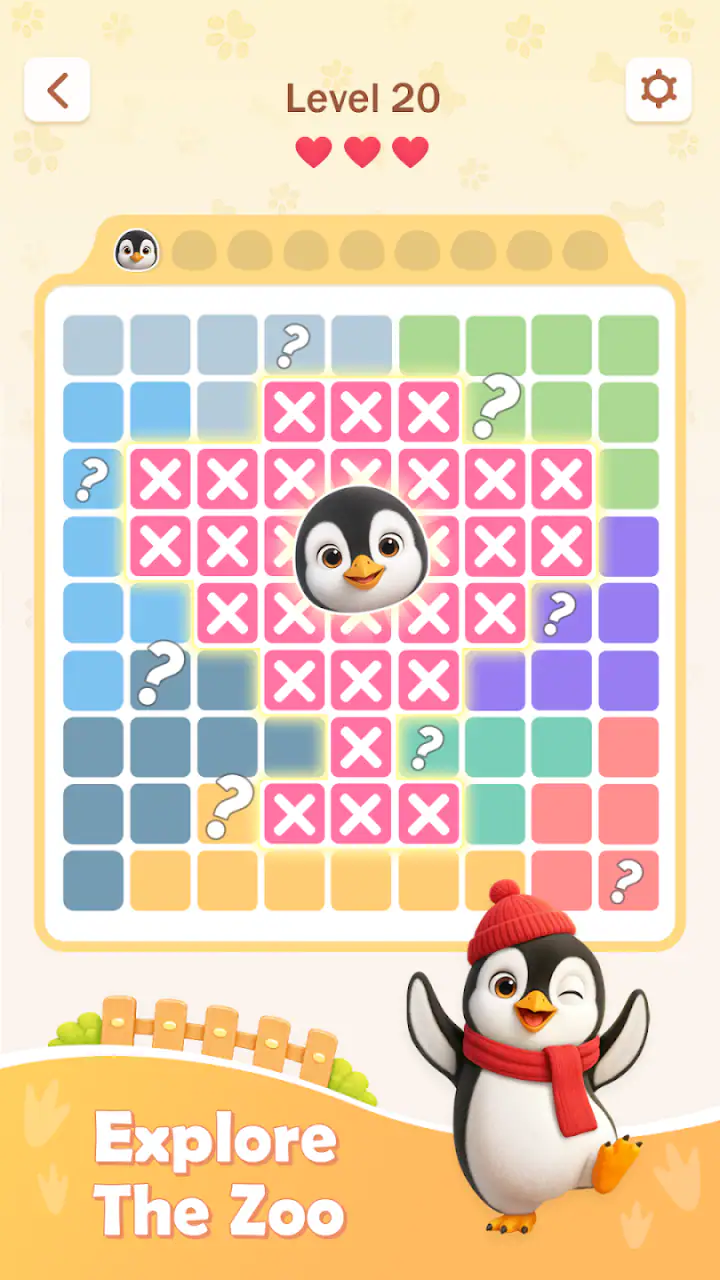
For a first-time player, the best setup is mental rather than technical. Put the phone somewhere you can look at the whole board without repeatedly changing your grip. If you are playing on a smaller screen, use deliberate taps and pause after each one. Puzzle games punish hurried input differently from action games: a single careless choice can make several later spaces appear confusing.
I also recommend beginning when you have enough attention to follow a pattern. A five-minute break can be perfect, but trying to solve while carrying on a complicated conversation is less enjoyable. The game’s relaxed presentation may suggest that it requires no concentration, yet the core challenge still benefits from uninterrupted thought.
Your first meaningful success
The first rewarding moment is not necessarily completing an entire board. It is recognizing why one animal must occupy one particular space. That is the point where the puzzle changes from a collection of empty cells into a set of connected clues. Once you make that placement, scan the neighboring areas again. A correct move often reveals another possibility that was previously hidden.
My preferred method is to separate certainty from possibility. First, find spaces with only one logical choice. Then look for an animal that has only one available position within its surrounding group. These two checks are more dependable than trying to fill the board from left to right. They also give beginners a repeatable routine instead of leaving them to guess what to inspect next.
When a board seems stuck, do not immediately erase everything or start tapping randomly. Recheck the most recent assumptions and compare the affected areas. Often the problem is not that the puzzle has become impossible; it is that a possible placement was mistaken for a certain one. This distinction is one of the most useful lessons the game can teach, and it applies to Sudoku-style puzzles well beyond this particular title.
A realistic everyday use case is a short evening break after work. I might open the game intending to complete only a small portion, solve a few connected spaces, and stop once I reach a natural pause. That is more comfortable than starting a long narrative game when I do not have the energy for a major commitment. The board gives my attention something specific to do without requiring a large time investment or a complicated control scheme.
For children or families, the animal presentation may provide a gentler entry point than a traditional puzzle app. I would still encourage an adult to explain the difference between testing a possibility and proving an answer. That conversation is more valuable than simply showing where to tap, because it turns the game into practice for patience and structured thinking.
Where beginners can become confused
The friendly theme can create an expectation that every move will be obvious. It will not. The animals make the board more inviting, but they do not remove the need to track relationships between spaces. If you are used to matching games where a correct answer is visible immediately, the slower discovery process may initially feel less rewarding.
Another source of confusion is treating each row or column as an isolated line. The useful clue is often found in the intersection between several parts of the board. When a space has multiple possible animals, inspect the surrounding group and then the corresponding lines. The answer may become clear only after you combine those views.
I would also avoid using speed as a measure of progress. A quick tap is not a better tap if it rests on an untested assumption. In my experience, the game is most enjoyable when I regard mistakes as information. If a later placement creates a contradiction, I can trace the chain backward and learn which earlier decision was too confident.
Players who are already expert at standard Sudoku may find the early experience familiar. That familiarity is helpful, but it can also make the first boards feel less demanding. The animal theme changes the presentation more than the underlying mental activity, so advanced solvers should approach it as a comfortable alternative rather than expecting a completely new puzzle discipline.
On the other hand, complete beginners may need a little patience before the logic becomes natural. The most useful adjustment is to stop searching for a flashy hint and instead ask a simple question: which space has the fewest possible choices right now? That question narrows the board and gives you a concrete next action. It is a better starting point than scanning every empty space equally.
How it compares with familiar alternatives
Compared with a conventional Sudoku app, this game has a more playful identity. A traditional version may be better if you want a minimal interface, a serious training atmosphere, or a presentation focused entirely on numbers and solving speed. Zoodoku is the better choice when visual warmth helps you return to the puzzle regularly.
Compared with fast matching games, it offers less immediate stimulation but more deliberate satisfaction. Matching games reward rapid recognition and repeated short actions. Here, the reward comes from building a conclusion step by step. If you want something to play one-handed while barely paying attention, this may not be the right option; the logic works best when you give the board a fair share of your focus.
It also differs from word puzzles because the challenge does not depend on vocabulary, spelling, or general knowledge. That makes it accessible across language backgrounds and useful for players who prefer visual reasoning. Someone looking for clues, definitions, or a story-driven puzzle should choose another category, while someone who likes structured deduction may find this format easier to revisit.
The theme is therefore more than decoration for the right audience, but it is not a substitute for variety. If your main requirement is a large collection of radically different puzzle mechanics, a broader puzzle collection may offer more range. I would choose this game for a focused animal-themed logic experience, not as the only puzzle title on my device.
Practical habits that make solving easier
My first concrete tip is to scan for restrictions before placing anything. Look across the relevant row, down the relevant column, and through the connected group. This three-part check takes longer than a guess but saves time when the board becomes dense. It is especially useful when two spaces appear interchangeable at first glance.
A second tip is to use pauses strategically. When I reach a point where several possibilities remain, I stop tapping and inspect the board from a different direction. Looking at animals one by one rather than spaces one by one can expose a placement that was easy to miss. This change of viewpoint is simple, but it prevents the common habit of staring at the same empty cell until frustration takes over.
A third insight is that the game can work as a transition activity. Instead of opening it only when bored, use a board as a boundary between tasks: finish a short logical sequence before starting an evening routine, or play until a natural solving checkpoint during a break. The clear beginning-and-pause rhythm is useful for people who want a small activity without being pulled into an endless feed.
A fourth trade-off is worth keeping in mind. The approachable animal style may encourage you to play longer than intended because the game feels harmless and light. If you are trying to protect your downtime, decide in advance whether you will stop after a certain number of solved sections or at a natural board break. The game is relaxing, but “relaxing” does not automatically mean time disappears unnoticed.
Who should try it, and who should skip it
I would recommend it to newcomers who want an uncomplicated way into Sudoku-style reasoning, families looking for a gentler visual presentation, and experienced solvers who enjoy a themed change of scenery. It is also a sensible choice for anyone who prefers games that can be approached in short sessions and resumed when concentration returns.
I would be more cautious if you need a highly competitive puzzle environment, a deep narrative, or constant mechanical variety. Players who dislike animal themes may find the presentation distracting rather than charming. Likewise, anyone expecting the game to teach advanced solving theory may outgrow the introductory appeal unless the available boards continue to provide enough challenge for their personal level.
The free price lowers the risk of trying it, and the Everyone rating makes it easier to share within a household. Still, the right decision depends on what you want from a puzzle. This is not a replacement for every kind of brain game; it is a focused option for visual logic with an approachable personality.
The next step after the first board
Once you have completed your first meaningful sequence, resist the urge to change your solving method every few minutes. Keep the same basic routine: identify the most restricted spaces, verify them across their connected areas, and revisit the board after each certain placement. Consistency makes it easier to tell whether a puzzle is genuinely difficult or whether a rushed assumption caused the confusion.
If you are introducing the game to another person, let them explain why a move works instead of correcting every tap. Asking “what makes that animal the only option?” encourages reasoning and keeps the experience collaborative. The visual theme gives you a natural way to make that conversation less formal, particularly with younger players.
For regular play, I would use it as a small rotation alongside a word game or a more experimental puzzle title. That combination prevents the familiar logic from becoming repetitive while preserving the calm, focused sessions that make this game appealing. It also gives you a clear answer about its long-term value: if you keep returning because the solving process itself feels good, the theme has done its job.
My overall view is positive, with a clear limit. Zoodoku is strongest as an approachable, animal-themed logic game for thoughtful short sessions. It makes the first step less intimidating, gives the familiar Sudoku structure a warmer identity, and rewards careful deduction rather than hurried tapping. Its main weakness is equally clear: players seeking dramatic variety or high-intensity action will probably find it too restrained.
For me, the deciding factor is how quickly the first successful action becomes understandable. You do not need to master the whole board immediately; you only need to find one placement that can be justified, then let that evidence guide the next scan. If that rhythm sounds satisfying, Nebula Studio’s puzzle is worth trying as a free, low-pressure addition to your Android game collection.
FAQs for Zoodoku
What is Zoodoku and how do you play it?
Zoodoku is a casual puzzle game that combines classic Sudoku-style number placement with a colorful animal theme. The main objective is to complete each puzzle by filling the grid correctly, making sure that numbers or symbols do not repeat in the same rows, columns, or sections. Its presentation is more playful than traditional Sudoku, making it approachable for both children and adults.
Is Zoodoku suitable for beginners who have never played Sudoku?
Yes, Zoodoku is generally accessible to beginners because its gameplay is based on familiar logic-puzzle rules and usually introduces the mechanics gradually. Early levels help you understand how the grid works before presenting more difficult challenges. Even if you are new to Sudoku, the simple interface and visual animal theme make it easier to learn through practice without feeling overwhelmed.
Does Zoodoku require an internet connection to play?
Zoodoku is designed primarily as a quick, casual puzzle experience, so many of its core levels can typically be played without a constant internet connection. However, certain features may depend on connectivity, including advertisements, updates, cloud-related functions, special events, or optional rewards. It is best to launch the game online at least once and check which features remain available offline on your device.
Is Zoodoku free to download, and does it include advertisements or purchases?
Zoodoku can generally be downloaded for free, but free access may be supported by advertising or optional in-app purchases. Depending on the version available in your region, you may encounter ads between levels or offers for additional hints, boosts, or other extras. Before downloading, review the store listing carefully, especially the in-app purchase information, so you know what to expect.
What devices are compatible with Zoodoku, and is it safe for children?
Compatibility depends on the version of Zoodoku available through the Google Play Store or Apple App Store, including the required Android or iOS version and available storage space. The game’s puzzle-focused design is generally family-friendly, but parents should still review its age rating, advertising, and purchase settings. If children will play, enabling parental controls is a sensible way to prevent accidental purchases.
Pros
- Simple sudoku rules make it easy for beginners to learn.
- Animal-themed visuals give the classic puzzle a friendly personality.
- Short levels fit well into quick breaks or daily play sessions.
- Gradual difficulty provides a comfortable challenge for casual players.
- Offline play is useful when you have no internet connection.
Cons
- Repetitive gameplay may feel limited for experienced sudoku players.
- Some puzzles can become frustrating without an undo or hint option.
- The cute presentation may not appeal to players seeking a serious style.
- Progression can feel slow if you prefer faster-paced puzzle games.
- Ads may interrupt play
- depending on the version and device.


